
Every time a flammable liquid moves through a hose, pipe or nozzle, it can generate static electricity. On its own that charge is invisible and harmless. Released as a spark into a flammable vapour, it can cause a fire or explosion in a fraction of a second.
As a UK specialist in reeling drums and powerfeed equipment, Metreel supplies earth bonding reels that make a safe static earth connection quick to apply and hard to overlook at the point of transfer. Static bonding and grounding is the most widely used control for this risk.
While not intended as a substitute for independent health and safety advice, this guide explains how static builds up during liquid transfer.
We’ll also cover the difference between bonding and grounding, what DSEAR requires of UK sites and how to put a reliable static earthing arrangement in place.
Why Static Electricity Is a Hazard With Flammable Liquids

Static charge is generated whenever two materials move against each other and then separate. With liquids, this happens constantly during transfer:
- Flow through pipes, hoses and filters
- Splash filling into tanks, drums and containers
- Agitation, mixing and pumping
- Spraying and nozzle discharge
Many common flammable liquids, including diesel, jet fuel, kerosene and solvents such as toluene, have low electrical conductivity. These are known as static accumulators because they hold charge rather than letting it drain away.
The real danger comes when that charge transfers to a conductive object that is electrically isolated. A road tanker standing on rubber tyres, a metal drum on a plastic pallet or an aircraft on a dry apron can all build up a significant voltage. When a person, nozzle or earthed structure comes close enough, the charge can jump the gap as a spark.
The energy needed to ignite many flammable vapours is very small, often below one millijoule. A static spark from an isolated metal object can easily exceed that, which is why static is treated as a credible ignition source wherever flammable atmospheres may be present.
Bonding vs Grounding: What Is the Difference?

The two terms are often used together, but they do different jobs.
Bonding connects two or more conductive objects together so they sit at the same electrical potential. With no voltage difference between them, a spark cannot jump from one to the other. An example is connecting a dispensing nozzle to the container being filled.
Grounding, usually called earthing in the UK, connects a conductive object to earth so that any charge drains away safely. A tanker connected to a verified earth point on a loading gantry is grounded.
In most transfer operations both are needed. Bonding keeps the equipment at the same potential and grounding makes sure that shared potential is held at earth rather than allowed to rise.
What DSEAR Requires
In Great Britain, the Dangerous Substances and Explosive Atmospheres Regulations 2002 (DSEAR) apply wherever flammable liquids, gases, vapours or combustible dusts are used or stored at work. Under DSEAR, employers must:
- Assess the fire and explosion risks from the dangerous substances on site
- Eliminate those risks or reduce them as far as reasonably practicable
- Classify areas where explosive atmospheres may occur into hazardous zones
- Select equipment that is suitable for the zone it is used in
- Control ignition sources, including static electricity
Hazardous areas are zoned by how likely an explosive atmosphere is to be present. Zones 0, 1 and 2 cover gases and vapours, while Zones 20, 21 and 22 cover dusts. Equipment used in these areas must meet the ATEX requirements for the relevant zone.
DSEAR does not prescribe a single piece of static control equipment. It requires a suitable risk assessment and effective controls. HSE’s Approved Code of Practice for DSEAR (L138) and the technical guidance IEC TS 60079-32-1, Explosive atmospheres: Electrostatic hazards, are the main references used to decide what those controls should look like.
The 10 ohm benchmark
IEC TS 60079-32-1 and the US equivalent, NFPA 77, both use 10 ohms as a practical benchmark for all-metal bonding and earthing circuits. A reading above this does not mean static cannot drain. It usually points to a loose, corroded or broken connection somewhere in the path. Checking that a static earthing circuit sits at 10 ohms or less is therefore a quick way to confirm it is in good condition.
Where Static Bonding and Grounding Is Needed
Any operation that moves a flammable liquid, gas or combustible powder between containers is a candidate for static control. Common applications include:
- Aircraft and helicopter refuelling: the aircraft, bowser or hydrant dispenser must be bonded before fuel flows
- Road tanker loading and offloading: the tanker is earthed at the gantry or delivery point before any hatches or valves are opened
- Rail tank cars: bonded to the loading rack and earthed throughout the transfer
- Fuel depots and storage terminals: tanks, pipework and loading arms all form part of the earthing system
- Marine bunkering: vessels and bunker supply equipment are bonded during fuel transfer
- Drum and IBC filling: metal drums and Ex rated IBCs are bonded to the filling point and earthed
- Solvents, paints and coatings: mixing vessels and decanting points where low conductivity solvents are handled
- Chemical and pharmaceutical processing: powder transfer into flammable solvents creates one of the highest static risks in industry
- Distilleries: high strength ethanol is flammable and transferred frequently between casks, tanks and tankers
- Grain, flour and powder handling: combustible dusts can ignite from static discharge in silos and conveying systems
Good Practice for Bonding and Grounding During Transfer
The details will depend on your DSEAR assessment, but most static control procedures share the same core steps:
- Connect first, disconnect last. Attach the earth clamp before opening any hatch, valve or cap and leave it in place until the transfer is complete and everything is closed
- Use a verified earth point. Connect to a dedicated, tested earthing point rather than a pipe, fence or structure that may not be reliably earthed
- Make metal to metal contact. Paint, rust and coatings can insulate the connection, so clamps need to bite through to bare metal
- Check the resistance. Test bonding and earthing circuits regularly and investigate any reading above 10 ohms
- Inspect cables and clamps. Look for frayed conductors, damaged insulation, weak clamp springs and loose terminations
- Train operators. Make sure everyone involved understands why the earth connection matters and the order in which it must be made
For higher risk operations, monitored static earthing systems can confirm the connection resistance continuously and interlock with pumps or valves, so a transfer cannot start until a good earth is in place.
Why Use an Earth Bonding Reel?
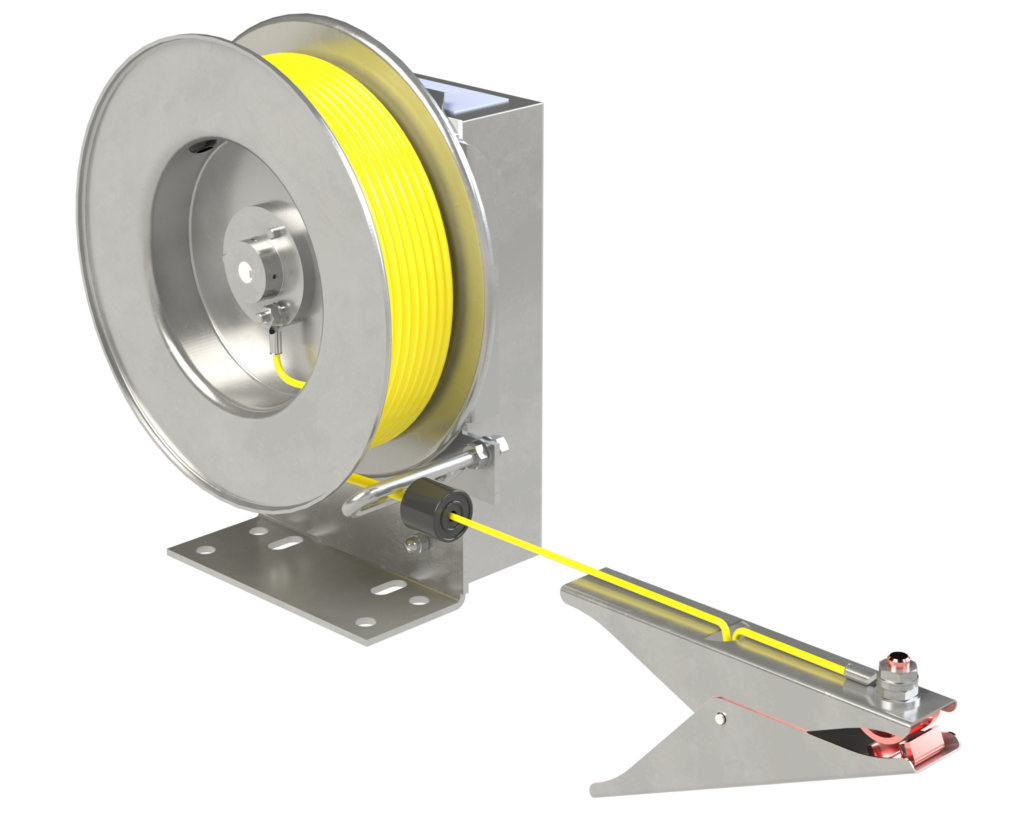
A loose earthing lead is one of the weakest links in many static control arrangements. Leads left on the ground get driven over, kinked and tripped on. They are easy to forget and a vehicle that pulls away with the clamp still attached can damage the cable or the earth point.
Earth bonding reels, also known as static earthing reels or static grounding reels, solve these problems by keeping the earth cable stored, protected and ready at the point of use.
Metreel’s range includes:
- Spring operated retraction so the cable returns to the drum after use rather than lying on the ground
- A stop-catch mechanism that holds the cable at the length needed during transfer, with an additional pull to retract
- Heavy gauge, zinc plated steel construction with a sealed heavy duty spring and protection against dust and water
- Arctic grade, low temperature cable rated from minus 20°C to plus 60°C, suited to outdoor aprons, depots and loading bays
- A low total earth path resistance of 0.25 ohms, comfortably within the 10 ohm benchmark
- Cable lengths from 15m to 40m, with a universal spring clamp included
For long reach applications such as aircraft refuelling and tanker bays, the 40m low temperature earth bonding reel gives operators plenty of slack to reach the vehicle without dragging the cable. Sites that already specify their own earthing cable can choose the earth bonding reel supplied without cable.
As with any equipment used around flammable atmospheres, check that the reel, clamp and mounting position are suitable for the hazardous area zone identified in your DSEAR assessment. Earth bonding reels sit alongside Metreel’s wider range of reeling drums for power and hose applications.
Earth Bonding Reels FAQs
Is a tanker earthed through its tyres?
No. Rubber tyres are generally insulating, so a tanker standing on them can be electrically isolated from the ground. A dedicated earth connection is needed before any transfer starts.
Can plastic containers be bonded and grounded?
Not with a standard earth clamp. Non-conductive plastic cannot carry charge to earth, so other controls are needed. Guidance generally advises against using ordinary plastic containers for static accumulating flammable liquids and favours conductive or dissipative alternatives.
What resistance should a static earthing circuit have?
For all-metal circuits, IEC TS 60079-32-1 and NFPA 77 use 10 ohms or less as the practical benchmark. Higher readings usually indicate a fault in the connection that should be investigated.
Does DSEAR require earth bonding reels?
DSEAR does not name specific equipment. It requires employers to assess explosion risks and control ignition sources, including static. An earth bonding reel is one practical way to make the earth connection reliable, quick to apply and hard to forget.
Get Advice on Static Earthing Equipment
Choosing the right reel length, mounting position and clamp depends on the vehicles, containers and hazardous zones at your site.
Get in touch with the Metreel team to talk through your application and find the right static earthing setup.