
Shackles are one of the most frequently specified components in any crane lifting assembly.
Whether you are connecting a chain sling to a workstation crane hoist or attaching a lifting attachment to a jib crane, the shackle is the critical link between the load and the lifting equipment. Choosing the wrong type can compromise the working load limit (WLL) of the assembly, create unnecessary wear or introduce a failure risk.
All shackles used in lifting operations in the UK should conform to BS EN 13889:2003, which specifies design, testing and marking requirements for forged steel shackles for general lifting purposes.
This guide covers the four main types of shackles used with workstation cranes and jib cranes, explains when each is appropriate and sets out the key selection criteria.
As LEEA (Lifting Equipment Engineers Association) members, the Metreel team is available to advise on shackle selection for your specific application.
Bow Shackles

The bow shackle, also called an anchor shackle, takes its name from the wide O-shaped loop that forms its body. This enlarged bow section allows multiple sling legs to be connected simultaneously, which makes bow shackles particularly suited to multi-leg lifting assemblies.
Because the bow can accommodate loads from more than one direction, these shackles are the standard choice where load dynamics are not strictly linear. For example, when lifting an irregular load that may shift position, or when using a two or four-leg chain sling. Bow shackles can handle angular loading without the risk of distortion that would affect a narrower shackle body.
In workstation and jib crane applications, bow shackles are commonly used where the crane is serving a general-purpose role across a variety of load types. WLL ratings under BS EN 13889 are marked directly on the body of the shackle and must not be exceeded.
Note: Bow shackles should not be side-loaded through the pin, as this can cause the pin to unscrew or the body to distort. The load should always be applied along the axis of the bow.
Dee Shackles
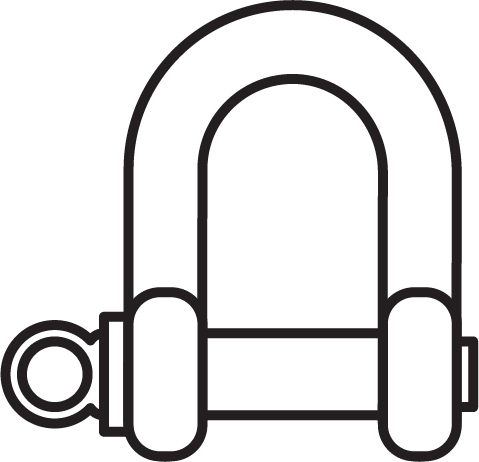
Dee shackles (or D shackles) have a shank which is in the shape of a letter D.
A dee shackle is narrow which restricts the load or sling movement to a single axis. This makes it suited for linear lifting operations where load flexibility isn’t required. Instead, dee shackles offer precise lifting for heavy loads, including when using workstation or jib cranes where simple vertical lifting is required.
Dee shackles are typically made from steel, including alloy steel, galvanised steel or stainless steel. This choice of materials allows the user to customise the shackle to the environmental conditions that the shackle will be exposed to.
Screw Pin Shackles

Screw pin shackles have a pin that screws into the body of the shackle. This connection type allows for ease of installation and removal, which can make screw pin shackles ideal for lifting jobs where there are frequent load changes.
For instance, in assembly lines where workstation cranes are used, the shackles may need to be swapped regularly. Screw pin shackles may offer the best solution depending on the load type.
Wide Body Shackles
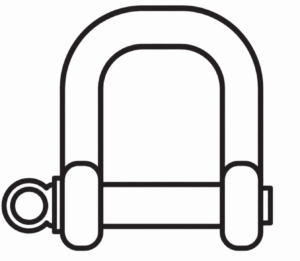
Wide body shackles are a variant of the bow shackle with an enlarged body profile. The increased internal width provides a larger bearing surface for the sling eye or lifting attachment, which distributes the load over a greater area and reduces point stress on synthetic slings in particular.
In jib crane applications, wide body shackles are often specified where:
- The load is large, awkwardly shaped, or requires more than one attachment point
- The assembly uses round slings or soft slings that are sensitive to narrow bearing surfaces
- Extended service life for the sling is a priority, as the reduced contact stress slows wear
Wide body shackles are heavier than standard bow shackles of equivalent WLL, which is worth factoring in for applications where the crane is operating close to its rated capacity.
Choosing the Right Shackle: Key Selection Criteria
When specifying shackles for use with a workstation or jib crane, consider the following:
- Load direction: If the load is strictly inline (vertical), a dee shackle is efficient. If the load may come from multiple angles or requires multi-leg sling attachment, specify a bow shackle.
- Working load limit: The shackle WLL must equal or exceed the maximum load to be lifted. The rated WLL is marked on the shackle body. Never use a shackle where the marking has become illegible.
- Frequency of connection changes: Screw pin shackles suit frequent load changes; bolt type or safety pin shackles are appropriate for fixed or long-duration assemblies.
- Sling type: Synthetic round slings benefit from wide body shackles to reduce bearing stress. Chain slings and wire rope slings are generally compatible with standard bow or dee shackles.
- Environment: Galvanised steel suits general industrial use; stainless steel is required for corrosive, marine or food-grade environments.
- Standards compliance: Specify shackles manufactured to BS EN 13889:2003. Shackles should carry the CE mark, the manufacturer’s identification, WLL and grade markings.
Shackle Inspection Under LOLER
Shackles used in lifting operations are lifting accessories under the Lifting Operations and Lifting Equipment Regulations 1998 (LOLER) and are subject to thorough examination. The frequency of examination depends on the nature of use, but for most commercial applications, thorough examination by a competent person is required at least every six months.
During thorough examination, the inspector will check for:
- Distortion of the bow or shank (which can indicate overloading)
- Wear at the crown of the bow or at pin contact points
- Thread damage or pin looseness
- Corrosion, cracking or surface damage
- Legibility of WLL and identification markings
A shackle that fails any of these checks must be withdrawn from service. Any shackle without legible markings should be treated as unfit for use until it can be identified and recertified.
As LEEA members, Metreel can arrange thorough examination of lifting accessories as part of a planned inspection program.
Get Expert Advice on Lifting Equipment & Accessories
Selecting the correct shackle for a crane lifting application requires an understanding of the load, the sling assembly and the operating environment. If you are specifying accessories for a workstation crane or jib crane installation and want to make sure the assembly is correctly rated and compliant, our team can help.
Discover our vast range of material handling equipment and accessories here at Metreel. Head over to our Jib Cranes page to view our cranes in greater detail and learn how they can improve safety and productivity in your workplace.
Or give us a call on 0115 932 7010 to speak to our sales team.